
Blog · Guides
Reverse Image Search for a Person
27 August 2026 · 8 min read

The DeepSearch profile screen puts a photo strip under the name. On the sample for Ethan Walker, Product Manager in California, three public portraits sit in a row next to a Confidence 85% shield. That strip is a pile of images the public web already attached to this identity. Reverse image search is the manual version of the same idea: take one picture and ask where else it appears.
Both methods fail in the same way. Cousins, stock-headshot twins, and old photos of someone else can look close enough. A lookalike is a hypothesis. It is not a confirmed match.
Google Images and Google Lens, by hand
If you already have a public photo (a speaker page, a company team shot, a press still), drag it into Google Images or long-press it in Google Lens. The useful hits are pages that reuse the same file: a conference programme, a faculty directory, a news caption with a name. Cropped memes and Pinterest reposts are noise.
Lens is faster on a phone. Desktop Google Images still wins when you need to open ten tabs and compare employers. Either way, stay on photos the person or their employer put on a public page. Do not pull images out of a private chat or a locked album and treat that as “open web.”
Screenshots of a screen, heavy filters, and cropped dating-app photos all weaken the match. Google often returns the same stock headshot sold to several consultants. If five “identical” faces resolve to five companies, you have a template, not an identity. A unique conference badge, a campus building, or a captioned news still is a better lead than a smiling portrait on a white background.
EXIF and reverse-image tools also will not open a private Instagram grid. If the only copy of a face lives behind a lock, public search has nothing to retrieve. DeepSearch’s photo strip has the same limit: it shows portraits already indexed with this profile, not a bypass of privacy settings.
What the profile photo strip actually is
DeepSearch does not replace Lens. It gathers publicly indexed photos into one profile so you can see them next to the identification paragraph and key details. If the strip is thin, the public footprint may be thin. If the strip is mixed (clearly different faces), you picked the wrong person or the sources collided. Go back to common name disambiguation instead of staring harder at the middle crop.
Confidence 85% on the sample profile is a source-agreement hint. It does not certify that every portrait in the strip is the same human. Open the original page for a picture that matters.
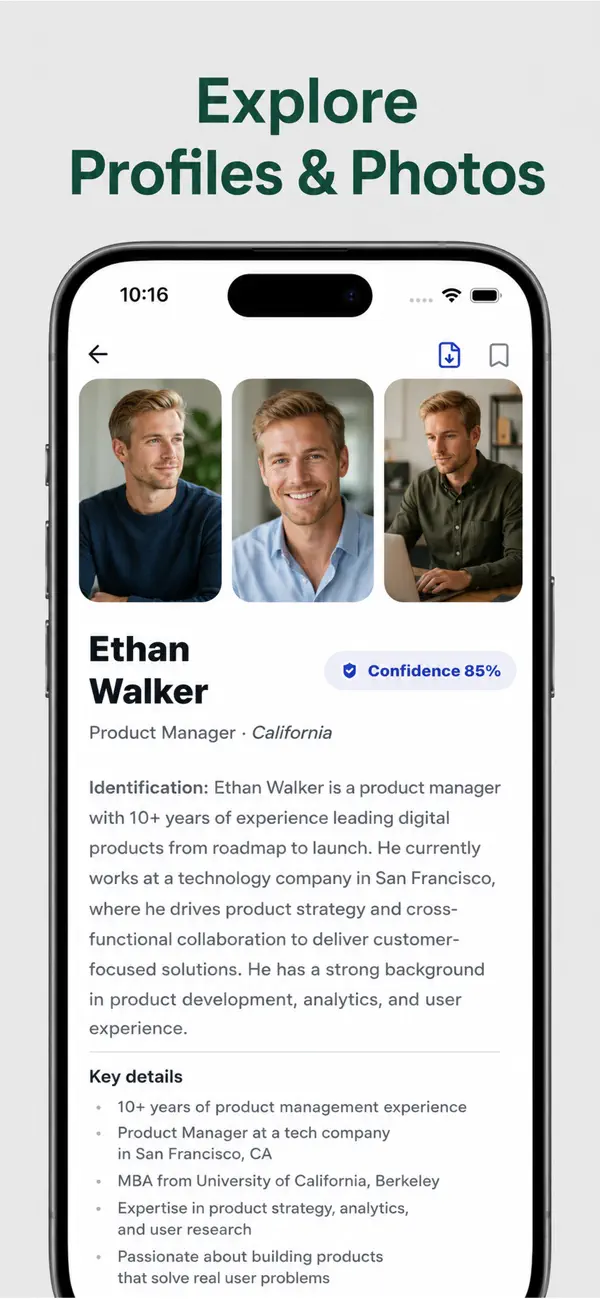
Search the name in DeepSearch and compare the public photo strip with what you already know. For a single image you already have, Google or Lens still works as a second pass.


A cautious order of operations
- Use a picture the person already published, or a photo strip on a public-web profile. Do not scrape private albums.
- Upload or long-press the image in Google Images or Google Lens and read pages that reuse the file.
- On the DeepSearch profile screen, compare the public portraits in the strip with the person you expected.
- If faces are close but employer or city disagrees, treat the hit as unconfirmed.
- Match a workplace, school, or unique caption on an independent public page.
This is public-web research. It is not an FCRA background check and it is not a criminal record pull. Face search is also a good way to fool yourself: lighting, ten years of aging, and a brother who looks similar will all produce “close” hits. When in doubt, require a non-photo fact. Related: how to find someone online.
Questions
Is a similar face enough to confirm you found the right person?
No. Lighting, age, and lookalikes fool both humans and image search. Confirm a workplace, city, or unique detail on a second public page before you treat a photo match as identity.
How is DeepSearch different from Google Lens for a person photo?
Google and Lens search from an image you already have. DeepSearch gathers publicly indexed photos into a profile photo strip after you search a name. Neither method opens private albums.
More guides