
Blog · Guides
Dating Safety: Public-Web Research Before You Meet
27 August 2026 · 8 min read

Before a first meeting, the useful question is narrow: does the public web agree with the name, city, job, and photos they already showed you? If a LinkedIn page, a company bio, and a public Instagram all point at the same person, you have a consistency check. If nothing public exists, that can also be normal. Thin footprints happen on purpose.
This is public-web research. It is not an FCRA background check. It will not tell you about credit, housing, employment, or a criminal record. It is not an excuse to scrape private accounts, demand passwords, or track someone in person. MapleByte Digital Ltd. is not a consumer reporting agency. Do not use the app to decide whether someone is “safe to hire” or “safe to house.”
What you are actually checking
Catfishing often fails a simple test: the face on the dating app does not match any public portrait attached to that name and city. Reverse image search and the photo strip on a people profile exist for that comparison. See reverse image search for a person. A lookalike is still a lookalike. Require a workplace or a unique caption on a second page.
Social tiles help when they are public. Instagram, LinkedIn, and X are the usual ones. Snapchat and Discord often stay blank because those products keep profiles off the open web. A missing tile is not proof of a fake. Read how to find social media accounts.
Conflicting photos are the usual hard stop: the dating profile shows one face, LinkedIn another, and the photo strip mixes both. Ask before you travel. A short video call is still something they chose to do, and cheaper than arguing with a lookalike on a platform. If they refuse any live check and the public pages disagree, treat that as the result.
Do not scrape a friends list, do not message an employer “to confirm,” and do not show up at a workplace you found on a team page. Public traces are for consistency with what they already told you. They are not a map for contact they did not invite. The sample profile for Ethan Walker shows Confidence 85% next to a photo strip. Use that as a hint that sources clustered, not as a character grade.
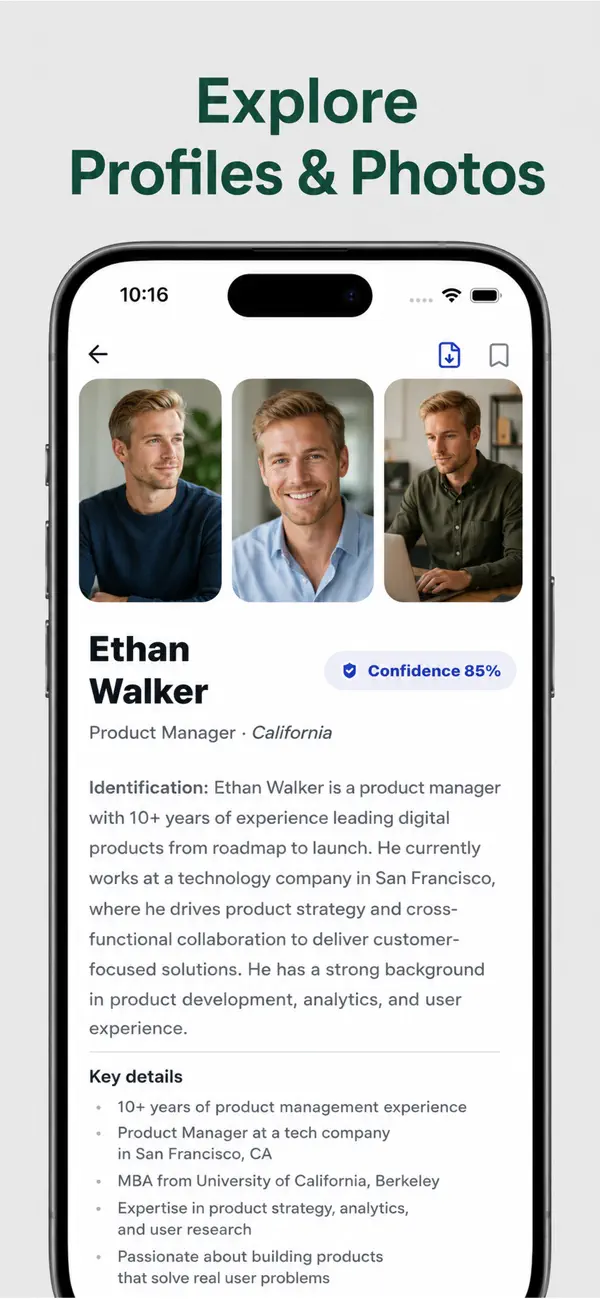
Search the name plus city in DeepSearch, pick the person, and compare public photos and socials with the dating profile. Stop at locked accounts.


A working order
- Write the name spelling, city, job title, and any username from the dating app.
- Run the name plus city in DeepSearch or a focused web search. Pick the right person if names collide.
- Compare the dating photos with the public photo strip and open public social tiles.
- Do not send follow requests just to inspect a locked profile.
- A consistent public footprint is a check, not a guarantee. Meet in public and tell a friend where you are going.
Lookups stay on your device workflow. The person is not notified. That still does not make it kind to weaponize old posts in conversation. For the legal line, read people search vs background check. If all you have is a first name, you will collide. See common name disambiguation.
Questions
Is looking someone up before a date a background check?
No. Checking public pages to see whether a profile is consistent is public-web research. It is not an FCRA background check and it is not a criminal record pull.
Does DeepSearch tell the person I searched them?
No. Lookups stay on your device workflow. The person is not notified. That is not permission to harass, scrape private accounts, or show up uninvited.
More guides